The Hygon DCU architecture, which future-proofs AI workloads within the EasyStack ecosystem, is positioned not just as an alternative, but as a full-performance competitor to NVIDIA’s current market leader in the GPU segment. The comparison below, showing the Hygon BW150 and BW1000-OAM models from a technical and commercial perspective against the NVIDIA A100 and H100 series, reveals a very exciting picture.
Hygon DCU: BW150 High-Performance PCIe Card
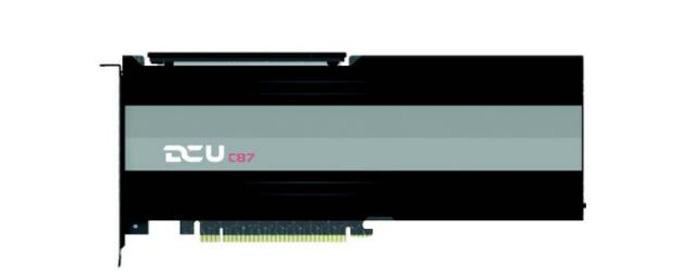
Hygon DCU BW150
When we look at the Hygon BW150 model, we see that it offers 376T FP16/BF16 and 752T INT8 computing power. Compared to the NVIDIA A100 (312 TFLOPS FP16), these values represent a raw power advantage of up to 20% on paper. With 64GB HBM2E memory and 1.8TB/s bandwidth, it provides system experts with tremendous flexibility in intensive model inference processes.
Hygon DCU: BW1000-OAM Module
HYGON DCU BW1000-OAM
The real performance powerhouse, the BW1000-OAM module, with its 8-board configuration, reaches the power of the 3840T FP16 and is designed for massive training clusters. EasyStack data proves that this solution delivers between 95% and 105% of the performance of the NVIDIA A100 in large model training, meaning it offers virtually identical efficiency to the A100.
In terms of inference, dense models achieve 65% to 105% of the A100’s performance, while MoE models achieve 75% to 85%. From a commercial perspective, this data explains why Hygon DCUs are the preferred choice, especially in private cloud projects, in terms of cost/performance ratio.
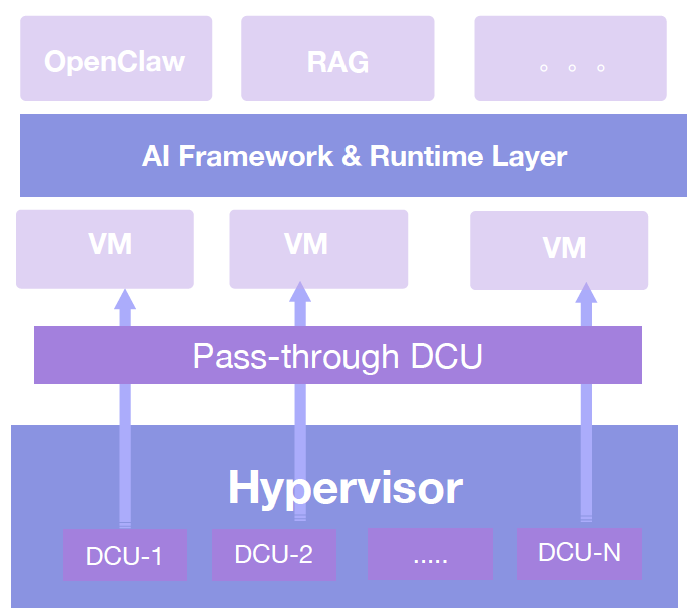
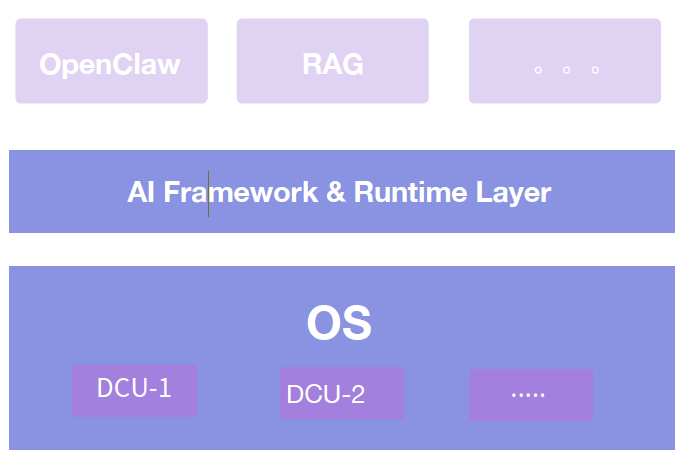
In our Server Room approach, technological independence and sustainability are our top priorities. With EasyStack’s Bare Metal or VM Passthrough options, we can use Hygon DCUs directly at the operating system level or at the virtualization layer with minimal loss (performance loss less than 5%).
When Should It Be Preferred?
Hygon BW150
Extensive model training and fine-tuning.
High computational intensity large model inference
High-performance large model training and fine-tuning
High computational intensity large model inference
High-performance scientific computing
HYGON DCU AND NVIDIA GPU TECHNICAL COMPARISON TABLE
Hygon DCU architecture is positioned as the strongest alternative to the NVIDIA ecosystem in high-performance computing and artificial intelligence projects. When we at Sistem Salonu examine these technologies, we see that Hygon’s value, especially in large language models (LLM) and complex inference processes, challenges and even surpasses A100 levels in some metrics.
Below, you will find a technical and performance-focused comparison of the Hygon BW150 and BW1000-OAM models used in the EasyStack platform against NVIDIA’s flagship processors.
FEATURE
HYGON BW150
HYGON BW1000 (Per Card)
NVIDIA A100 (SXM)
NVIDIA H100 (SXM)
Architectural
DCU 2.0
DCU 3.0
Ampere
Hopper
FP16/BF16 Power
376 TFLOPS
480 TFLOPS
312 TFLOPS
1000 TFLOPS
INT8 Performance
752 TOPS
960 TOPS
624 TOPS
2000 TOPS
Memory Capacity
64 GB HBM2E
64 GB HBM2E
80 GB HBM2e
80 GB HBM3
Memory Bandwidth
1.8 TB/s
1.8 TB/s
2.0 TB/s
3.35 TB/s
TDP (Power Consumption)
~350W
~400W
400W
700W
Typical DCU Activation Scenarios
VM with DCU passthrough
Suitable for multi-tenant development and testing with inference workloads that do not require high performance.
Advantages: Performance loss < 5%, good functional compatibility, simple technical implementation, low operating and maintenance costs;
Disadvantages: DCU devices cannot be shared with other VMs, and VMs with DCUs installed do not support live migration;
Bare Metal with DCU
Suitable for formal production deployment and training inference workloads with high performance requirements.
Advantages: Compared to DCU-based VM solutions, there is no performance loss due to the virtualization layer.
Disadvantages: The DCU cannot be shared with another tenant.
PERFORMANCE AND COMMERCIAL EVALUATION
Training Performance
Hygon BW1000-OAM modules deliver between 95% and 105% of the training capabilities offered by the NVIDIA A100, according to EasyStack test data. This proves that Hygon competes in exactly the same class as the A100 and gives system experts complete confidence in training large models.
Inference Performance
In dense models, Hygon DCUs can achieve performance levels starting from 65% of the A100 and reaching up to 105% depending on model optimization. In mixed-effect (MoE) models, they exhibit performance in the 75%-85% range, offering tremendous efficiency in terms of cost/performance for our System Hall projects.
Hardware and Integration Advantage
These components, fully compatible with Lenovo WA5480 G5 and WA5680 G3 servers on the EasyStack platform, operate with less than 5% performance loss at the virtualization layer (VM Passthrough). This makes resource management within the System Room both flexible and extremely fast.
Business Strategy and Independence
For organizations seeking technological independence, using Hygon DCUs provides access to computing power similar to the NVIDIA ecosystem at much more affordable costs. In our System Hall approach, we consistently deliver the latest and most efficient technology with a positive vision.
In light of this benchmark data, would you like us to perform a capacity analysis to determine which of the BW150 or BW1000 models is more suitable for your current workloads?